Program/Project Control 101: Know Your Contract, Know Your Numbers, Know Your Project


Program/Project Control (PC) is one of those functions that can look completely different from one government contractor to another. At one company, PC may own budgeting, forecasting, revenue, funding, variance analysis, and financial reporting. At another, some of those responsibilities may sit with Accounting, Contracts, Finance, or the Program Manager. But regardless of where the lines are drawn on the org chart, I believe a strong PC professional needs to understand the entire financial and contractual picture of the project they support.
PC is not just about updating spreadsheets and producing reports. A good PC professional is one of the project's most important gatekeepers. And that starts with three things:
Know your contract. Know your numbers. Know your project.
1. Read the Contract — Yourself
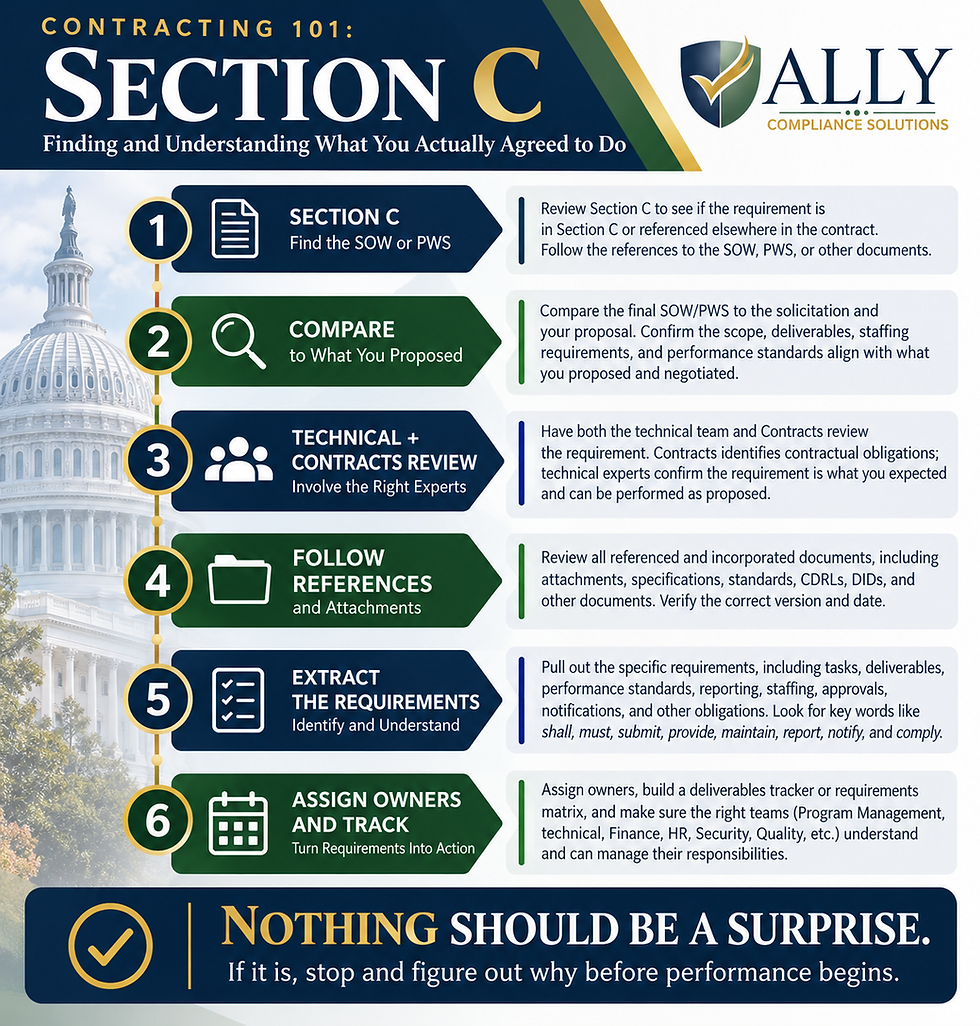
One of the first things a PC professional should do when assigned to a project is read the contract. Not just the statement of work. Read the contract. Understand the CLIN structure. Look at the funding and accounting lines. Find the billing instructions. Know the periods of performance. Understand what costs are billable and how they are billed. Know the deliverables and when they are due. Contracts may be responsible for communicating contractual requirements to the program team, and that's exactly how it should work. But that doesn't mean PC shouldn't know how to find those requirements independently.
I have always been a big believer in trust, but verify.
If I'm responsible for monitoring the financial health of a project, I want to see the source document myself. That becomes particularly important when it comes to funding. A $10 million contract does not necessarily mean you have $10 million available to spend. PC needs to understand the difference between contract value, ceiling, funded value, and the amount currently available for the work being performed. You also need to understand when that funding can be used. Funding, CLIN structure, periods of performance, options, task orders, and other contractual limitations can all affect what the project is authorized to do. Knowing that you have money is only half the equation. You need to know whether you can spend it.
2. Go Back to the Proposal
Once you understand the contract, go find the proposal and understand how the work was priced. What assumptions did the company make when it decided this work could be performed profitably? For a T&M contract, what indirect rates were used to develop the proposed labor rates? For a cost-reimbursement contract, what indirect rates were proposed? What fee or profit was targeted? How many productive hours were assumed for an FTE? What labor categories were proposed? What salaries or hourly rates were assumed? Was escalation included? What was budgeted for travel, ODCs, subcontractors, consultants, materials, or other direct costs? These aren't questions that stop being relevant once the proposal is submitted. After award, those assumptions become your baseline.
If you don't know what you planned, how can you explain why actual performance is different? Maybe the proposal assumed a certain labor mix, but the project is using more senior employees. Maybe an employee's actual salary is significantly higher than the amount used for pricing. Maybe the project is using more hours than anticipated. Maybe indirect rates have changed. Maybe travel wasn't included in the original assumptions. Any one of those things can change the financial outcome of the project. PC needs to know what the original plan was before it can effectively monitor where the project is going.
3. Understand Your Company's Indirect Rates
This is a big one for me. A PC professional working in government contracting should understand the company's indirect rate structure. Not just know where the rates are stored. Actually understand it. What costs receive fringe? What is included in the overhead allocation base? Does the company have multiple overhead pools? How is G&A allocated? In what order are the burdens applied? What costs are excluded from certain allocation bases? How are the rates calculated? And yes, I believe a PC professional should be able to calculate a fully burdened labor rate. Over the last few years, I interviewed at least 20 candidates for PC positions. One of the questions I liked to ask was how they would calculate a fully burdened labor rate. I was surprised by how many couldn't explain it. Instead, the answer was some variation of:
"I put the information into the spreadsheet and it calculates it."
That's a problem. Excel, Costpoint, and other systems are fantastic tools. We should absolutely use them. But the tool shouldn't be the reason you understand the number. A strong PC professional should be able to take a labor rate, apply the appropriate indirect burdens, and confidently determine the fully burdened cost. More importantly, they should understand why the answer is what it is. Because when the spreadsheet, report, or system produces a number that doesn't make sense, someone needs to recognize it.
4. Build a Project Budget — Even If Nobody Asked for One
If the contract requires a project budget, great.
If the customer requires a spend plan, great.
If neither one is required?
Build one anyway.
A good project budget is one of the most useful tools PC can have. Depending on the contract, that budget may include:
Labor hours and dollars by employee or labor category
Fringe, overhead, G&A, and other indirect costs
Travel
Materials and ODCs
Subcontractors and consultants
Revenue
Profit or fee
Funding
Expected billing
Staffing assumptions
Periods of performance
Then compare actual performance against the plan and continuously update the forecast. Without a budget, you can tell the Program Manager how much has been spent. With a budget and forecast, you can tell the Program Manager whether the project is on track and where it is likely to finish. Those are very different levels of information.
5. Understand Revenue and Profit — Not Just Cost
PC shouldn't stop at tracking expenses. You should understand how revenue is calculated or recognized for the contract you support. You should understand how profit or fee is generated. And you should budget both. If the company expected a certain margin when the work was priced, PC should be able to see when that margin begins moving in the wrong direction. That also means understanding the difference between reporting history and forecasting performance.
Knowing what happened last month is useful. Knowing what is likely to happen six months from now is much more valuable. If the project continues operating at its current burn rate, where will it land? What is left to spend? What is left to bill? How many labor hours remain? What is the estimate to complete? What does that make the estimate at completion? Are current staffing decisions improving or hurting the expected margin? You do not need a formal EVMS requirement to apply basic forecasting discipline to a project. Good PC should help management see problems while there is still time to do something about them.
6. Understand the Billing
Maybe invoicing isn't in your job description. Learn it anyway. If the biller runs into a problem with one of your projects, there is a very good chance PC will be one of the first calls. Be ready.
Understand how your contract bills. Know the billing rates. Know which CLINs are being billed. Know what is and isn't billable. Understand the funding. Know whether there are contractual billing limitations or special instructions. Understand how subcontractor costs, travel, ODCs, fee, indirect rates, or other costs are treated. You don't necessarily have to prepare the invoice. But you should understand it well enough to recognize when something doesn't look right and help figure out why.
7. Don't Just Report Variances — Explain Them
Imagine telling a Program Manager: "Labor is $20,000 over budget."
Okay. Why?
That is where PC adds value. Did employees work more hours than planned? Is the project using a more expensive labor mix? Did someone charge to the wrong project? Did a staffing change occur? Were salary assumptions different from actual salaries? Did indirect rates change? Did the schedule move? Is this simply a timing variance that will correct itself next month? A variance tells you where to look. PC needs to figure out the story behind it. And then ask the next question:
What does this mean for the rest of the project?
8. Be the Gatekeeper
This may be the most important part. PC should know what is happening on the project financially. A new employee starts charging time? PC should know. Someone plans travel? PC should be checking the budget, funding, and applicable contract requirements before the trip happens. A subcontractor is performing more work than forecast? PC should know. Labor hours suddenly increase? Ask why. A strange cost appears in the actuals? Investigate it. A funding threshold is approaching? Don't wait for someone else to notice. That doesn't mean PC owns every decision. Contracts owns contractual administration. Accounting owns the books and may own invoicing. The Program Manager owns program execution. But PC sits at the intersection of all of them. The PM knows what is happening operationally.
Contracts understands the contractual requirements. Accounting knows what has hit the books.
PC helps connect those pieces and translate what is happening into the financial health of the project. That is an incredibly important position to occupy.
Program/Project Control Is More Than a Spreadsheet
The best PC professionals I've worked with weren't human spreadsheets. They understood the contract. They understood accounting. They understood pricing. They understood indirect rates. They understood the program. They knew the people charging to it. They knew what was budgeted. They knew what was funded. And they asked questions when something didn't make sense. A spreadsheet can calculate a fully burdened labor rate. A system can generate a variance report. An accounting system can tell you how much has been spent. But none of those things replaces someone who understands what the numbers mean, recognizes when something is wrong, and knows which questions to ask next. That's the real value of good PC.
Know your contract. Know your numbers. Know your project.


Comments