Contracting 101: The Sections You Can't Afford to Skim

I've worked with several small businesses over the years that did exactly what they thought they were supposed to do when a new contract arrived. Someone reviewed the award, checked the funding, looked at the scope and dates, and made sure the important information made its way to the appropriate people.
Sections H and I were reviewed too.
But here's the problem: nobody ever raised a question about them.
Not because there was never anything to question. In many cases, those sections were treated as standard contract language - something to acknowledge rather than something that might require the company to establish a process, assign responsibility, submit a notification, obtain approval or maintain evidence of compliance.
That distinction matters. Reading a requirement is not the same thing as implementing it.
So far in our Contracting 101 series, we've spent time on Section B, scope and Section F. Those are the places people naturally gravitate toward because they answer some of the most immediate questions: What did we win? How much is it worth? What are we supposed to do? When are we supposed to do it?
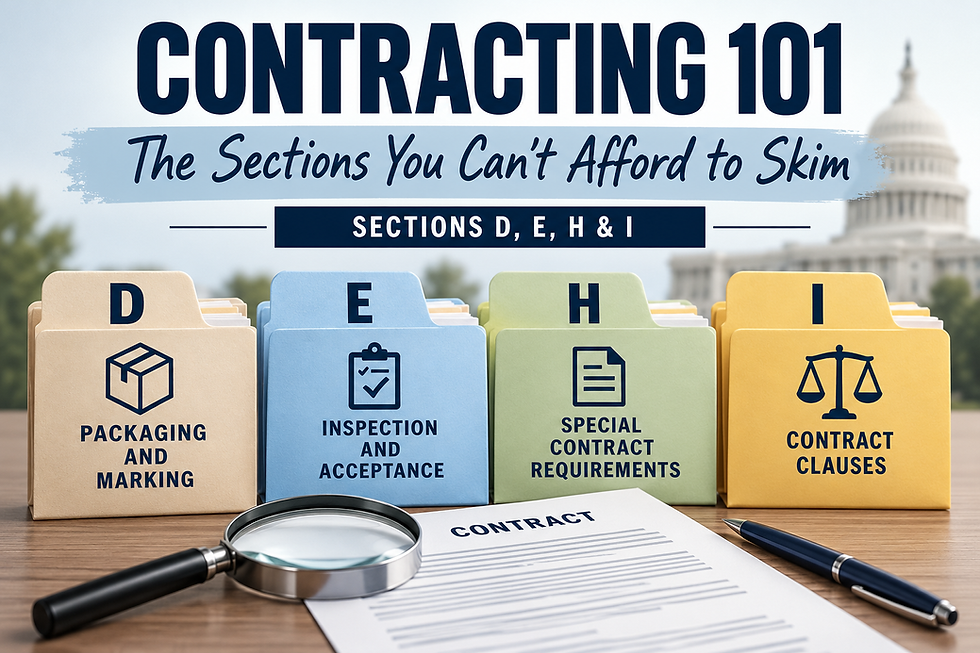
Sections D, E, H and I may not get the same attention, but there can be requirements hiding in these sections that create very real contractual and financial risk.
Section D: Packaging and Marking
Under the Uniform Contract Format, Section D addresses packaging, packing, preservation and marking requirements.
For many professional-services contractors, there may not be much here. For a contractor delivering equipment, material or other physical products, it can be a very different story.
If requirements are included, don't dismiss them as shipping details. Determine what is being delivered, how it must be packaged or preserved, what markings or labels are required, and whether those requirements need to make their way into your shipping, warehouse, quality or subcontractor processes.
This is a simple example of why contract review shouldn't happen in a vacuum. Contracts Administration may understand the requirement, but that doesn't help much if the person preparing the shipment has never seen it.
Section E: Delivery Is Not the Same as Acceptance
Section E addresses inspection and acceptance, including applicable quality assurance requirements.
This is one of those sections that services contractors can be tempted to skim because "inspection" sounds like something that applies to a box of parts coming off a production line.
It doesn't stop there.
The Government can inspect contracted services too, and the contract may establish requirements for how supplies, services or deliverables are inspected and accepted. You need to understand what is subject to inspection, who has authority to accept it, where acceptance occurs and whether there are specific quality or documentation requirements associated with that acceptance.
Imagine a team completes a required deliverable and sends it to its normal Government point of contact. Everyone considers it done. But the contract requires formal acceptance by a different authorized Government representative.
Was it actually accepted?
That's a question you want answered before it turns into an invoicing or payment problem.
Section H: This Is Where I Slow Down
Section H contains special contract requirements that aren't included elsewhere in the Uniform Contract Format. In practical terms, that means you don't know what you're going to find there until you read it.
I've had a contract where Section H contained special instructions for base closures. If the base closed, the contractor couldn't simply decide that employees would continue working and charge the contract. We needed written permission from the Contracting Officer to perform work during the closure.
We didn't follow the requirement.
The employees worked, the costs were invoiced, and the costs were denied.
That wasn't an obscure accounting issue that Project Control could fix after the fact. The contract told us what was required, and we didn't follow it.
That's why I don't like seeing Section H reviewed with a checkmark that simply means, Yes, I read it.
The better questions are:
What does this require us to do differently?
Who needs to know?
Does someone need written approval before taking an action?
Is there a notification requirement?
Is there something we need to track?
What is the risk if we don't comply?
Section H can contain requirements involving key personnel, travel, security, staffing, Government facilities, approvals, notifications, organizational conflicts of interest, Government property and any number of other contract-specific subjects.
And that's exactly why experience with another contract's Section H doesn't tell you what's in this one.
Section I: Clauses Are Not Boilerplate
Section I contains the contract clauses, and this is another place where I see eyes start to glaze over.
There can be pages and pages of Federal Acquisition Regulation (FAR) clauses, clauses from agency-specific FAR supplements and other applicable clauses. Eventually they can start to look like standard legal language that someone else has already taken care of.
Don't make that assumption.
The objective isn't for the Contracts Administrator to memorize every clause in the FAR. The objective is to understand which clauses apply to your contract and what those clauses require your company to do.
Take the Limitation of Funds (LOF) and Limitation of Cost (LOC) requirements applicable to certain cost-reimbursement contracts. These aren't clauses you acknowledge at award and forget about. They create ongoing responsibilities associated with monitoring costs and providing required notice as you approach specified funding or cost thresholds.
If someone reviewing your contract administration asks how your company manages that requirement, you want a better answer than, "Our Contracts Manager watches it."
How is it monitored? Who provides the financial data? How frequently is it reviewed? Who determines when notice is required? Who prepares and submits the notice? Where is it documented? Can you produce the notices you've submitted?
Compliance should leave evidence.
The same concept applies to other requirements.
A contract may contain requirements involving business ethics and conduct. Depending on the applicable requirements, a contractor may need a written code of business ethics and conduct, an employee awareness program, internal controls, reporting mechanisms or other processes. If someone asks how your company complies, can you show them?
Organizational Conflicts of Interest (OCI) are another example. Depending on the contract and applicable requirements, the company may have obligations involving identification, disclosure, avoidance, mitigation or monitoring of potential conflicts. If your contract requires an OCI mitigation plan or another specific process, that requirement shouldn't sit in Section I while the rest of the company operates without knowing it exists.
The point isn't that every contractor needs the same policy for every clause. They don't.
The point is that when your contract creates an obligation, your organization needs a way to satisfy it and, when appropriate, evidence that it did.
The Government Can Be Wrong Too
There is another assumption I see frequently with small businesses: if the Government put it in the contract, it must belong there.
Not necessarily.
Contracts are prepared by people, and people make mistakes. A solicitation or award can include a clause that doesn't appear to fit the contract type, scope or circumstances of the acquisition. A clause pertinent to a cost-reimbursement contract may show up in a firm-fixed-price award. A requirement may conflict with another part of the contract. Something may have been carried forward when it shouldn't have been, or something you expected to see may be missing.
I've seen contractors handle this in two ways. Some don't notice the inconsistency at all. Others notice it but decide, That doesn't apply to us, so we'll just ignore it.
Neither is a particularly good contract administration strategy.
If a clause is included in your contract and doesn't appear to apply, don't simply decide that it doesn't matter. Research it. Look at the clause prescription and applicability. Determine whether it creates an obligation or risk for your company. If something doesn't make sense, raise the question before accepting the award when possible.
And yes, sometimes the answer really is that the Government made a mistake. Shocker, but I said it.
That doesn't mean every discrepancy needs to become a battle with the Contracting Officer. I completely understand why a small business pursuing an important award may be reluctant to push back on every questionable term. Sometimes a contractor identifies a risk and makes a business decision about how aggressively it wants to pursue the issue.
That's a decision a company is absolutely allowed to make.
But it should be an informed business decision, not an accidental one.
There's a big difference between "We didn't realize that clause was in there" and "We identified the clause, evaluated its applicability and potential risk, and made a deliberate decision about how we wanted to proceed."
The same principle applies outside Section I. If something in Sections D, E or H seems inconsistent with the rest of the contract, don't assume the Government must know something you don't.
Ask the question.
Contract review isn't only about determining what the Government expects from you. It's also an opportunity to identify ambiguity, inconsistency and unnecessary risk before those words become part of the contract you're responsible for performing.
A Checkmark Isn't Contract Administration
This is where I think small businesses can get into trouble.
Someone performs a contract review and produces a beautiful checklist:
Section B - reviewed.Section C - reviewed.Section F - reviewed.Section H - reviewed.Section I - reviewed.
Great.
What happened next?
If Section H requires Contracting Officer approval before employees work during a base closure, where is that requirement tracked?
If a clause requires notification as costs approach a particular threshold, who is monitoring it and where is the evidence?
If the contract creates an ethics requirement, who owns the applicable process?
If an OCI requirement applies, who evaluates potential conflicts and maintains the documentation?
If Section E establishes specific inspection and acceptance requirements, does the Program Manager know what they are?
Those are the questions that matter after the review is finished.
That's the difference between contract review and contract administration.
This Is Why We're Building Toward a Compliance Matrix
As we work through the contract in this series, we're collecting more than information.
We're collecting obligations.
Some have dates. Some have thresholds. Some require Government approval. Some require recurring reports. Some require a company process. Some need to be communicated to employees. Some belong to Contracts Administration, while others belong to Project Control, Accounting, Human Resources, Security, Quality, Program Management, Information Technology or another function.
Eventually, we're going to take those requirements and build a contract compliance matrix that identifies what the requirement is, where it came from, who owns it, when it has to happen and how we know it was completed.
That's also why we're deliberately not jumping straight from Section B into project setup.
Before we build the project, we need to understand the contract well enough to know what the project needs to support.
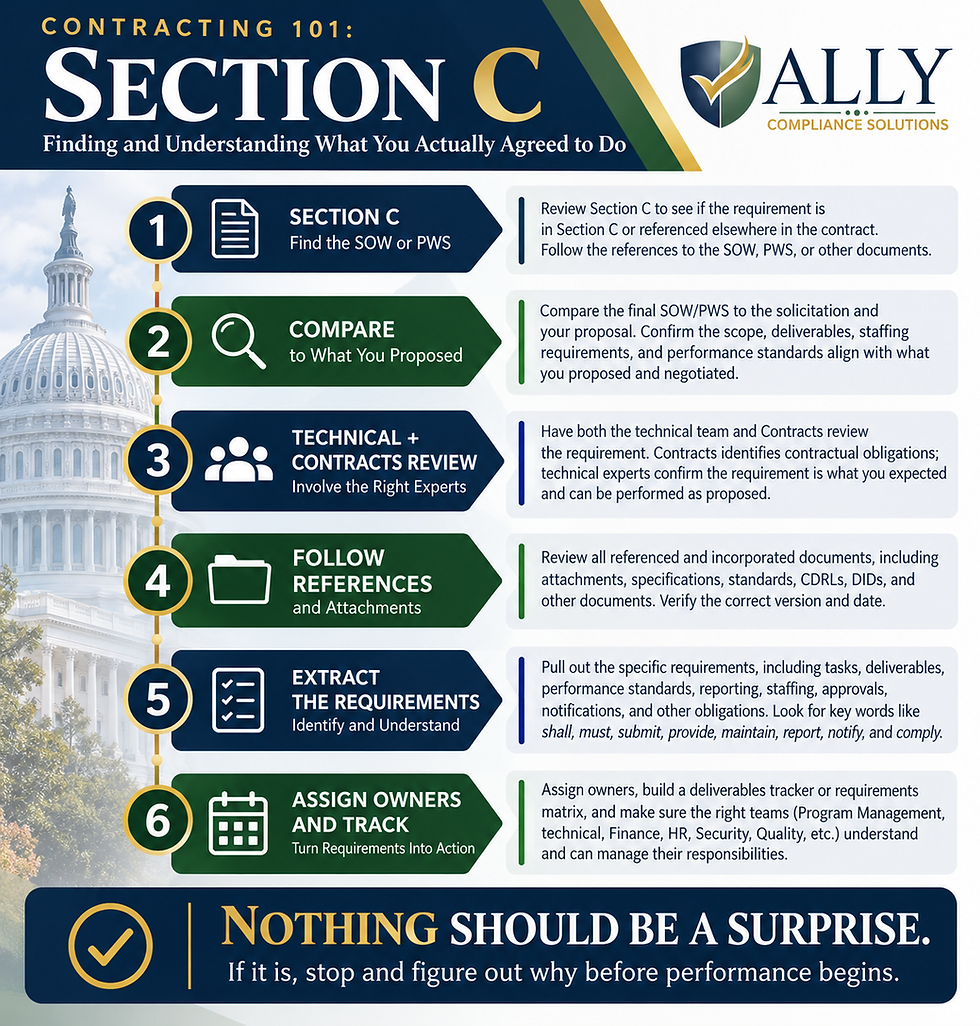
We still have another major source of requirements to work through: Section J and the attachments behind it, including Contract Data Requirements Lists (CDRLs), Data Item Descriptions (DIDs) and other documents that can create very specific performance and reporting obligations.
Because ultimately, the goal isn't to prove that someone read every page of the contract.
It's to be able to demonstrate that the company did what those pages required.


Comments