Contracting 101: How to Read a Government Contract


You just received a government contract. Congratulations!
Now what?
If you're new to government contracting, opening that first award can be overwhelming. There may be a cover form, pages of contract line items, a statement of work, special requirements, FAR or agency-specific clauses, and a collection of attachments that may or may not have arrived in the same file.
The good news is that traditional federal contracts generally have a recognizable structure. Once you understand how the pieces fit together, reviewing an award becomes much easier.
One important caveat before we start: this discussion is focused on traditional federal procurement contracts. Other agreement types can look very different. An Other Transaction Agreement (OTA), for example, is not a FAR procurement contract and shouldn't be expected to follow the structure described below.
Before you start interpreting clauses, establishing projects or planning performance, start with a much more basic question:
Do you actually have the entire contract?
Start with the Award Document
Depending on the acquisition, the first page may look different. Three Standard Forms (SFs) worth recognizing are the SF 26, SF 33 and SF 30.
SF 26 – Award/Contract. Think of this as the government's award cover sheet. It identifies key information about the contract, the parties and the award.
SF 33 – Solicitation, Offer and Award. As the name suggests, this form can serve multiple purposes throughout the acquisition process. It may begin as part of the solicitation, become part of the contractor's offer and ultimately document the government's award.
SF 30 – Amendment of Solicitation/Modification of Contract. You'll become familiar with this one after award. Before award, an SF 30 may document an amendment to the solicitation. After award, it's commonly used to document a contract modification.
We'll spend much more time on modifications later in the Contracting 101 series. For now, when you're reviewing the initial award, your first job is to understand exactly what the government awarded.
Don't Skip the First Page
It's tempting to treat the cover page as administrative information and immediately flip past it to get to the "real" contract.
Don't.
Pay attention to the blocks that are checked or marked with an X. The award form can identify which portions of the solicitation, offer and other documents are incorporated into the resulting contract.
If the cover page says something is included or incorporated, verify that you have it.
A 200-page PDF can still be an incomplete contract file.
This is one of the first things I check when reviewing an award:
Does what I received match what the award document says should be there?
Keep that question in mind, because we're going to perform essentially the same exercise again when we reach Section J.
Understanding the Contract Structure
For many traditional federal contracts, you'll encounter the Uniform Contract Format (UCF). The Federal Acquisition Regulation (FAR) organizes the UCF into four parts and Sections A through M.
The UCF isn't universal, and FAR 15.204 provides exceptions, so don't assume every federal contract you encounter will look exactly like this.
For contracts that do use it, here's what you're looking at—and, more importantly, what you should do with it during your award review.
Section A – Solicitation/Contract Form
Translation: Start here.
Section A is the solicitation or contract form. It provides basic identifying information for the procurement and, at award, helps establish what was actually incorporated into the contract.
Don't just verify the contract number and move on. Check the contractor information, issuing office, award information, signatures and dates as applicable. Most importantly, look carefully at the checked boxes and references to incorporated material.
If Section A tells you another document or section is part of the contract, make sure you can locate it.
Who should pay attention: Contracts Administration should lead this review, but the basic award information should be verified before the contract is handed off to the operational and financial teams.
Section B – Supplies or Services and Prices/Costs
Translation: What did the government buy, how is it structured, and what did it agree to pay?
This is where you'll generally find the contract's line-item structure, including Contract Line Item Numbers (CLINs) and, when applicable, Subline Item Numbers (SLINs). You may also encounter Accounting Classification Reference Numbers (ACRNs) associated with the funding and accounting structure of the award.
Section B should not contain a surprise.
The quantities, pricing, contract type and line-item structure should reflect what was proposed, negotiated and ultimately agreed upon. As part of your award review, compare Section B to the final proposal and negotiated position. If the government awarded something differently from what you believe was agreed upon, now is the time to identify it—not after you've begun performing, charging or invoicing.
Section B is also extremely important to the people who will translate the contract into your company's accounting and project-management structure. CLINs, SLINs, funding structure and contract type can all influence how the project should be established and managed internally.
That doesn't necessarily mean your accounting-system project structure should mirror Section B line-for-line. It means Section B is one of the pieces that should inform that decision.
We'll tackle project setup separately because that deserves its own Contracting 101 discussion.
Who should pay attention: Contracts Administration, Pricing, Accounting/Finance, Program or Project Management, Program/Project Controls, and whoever is responsible for establishing the project in the accounting system.
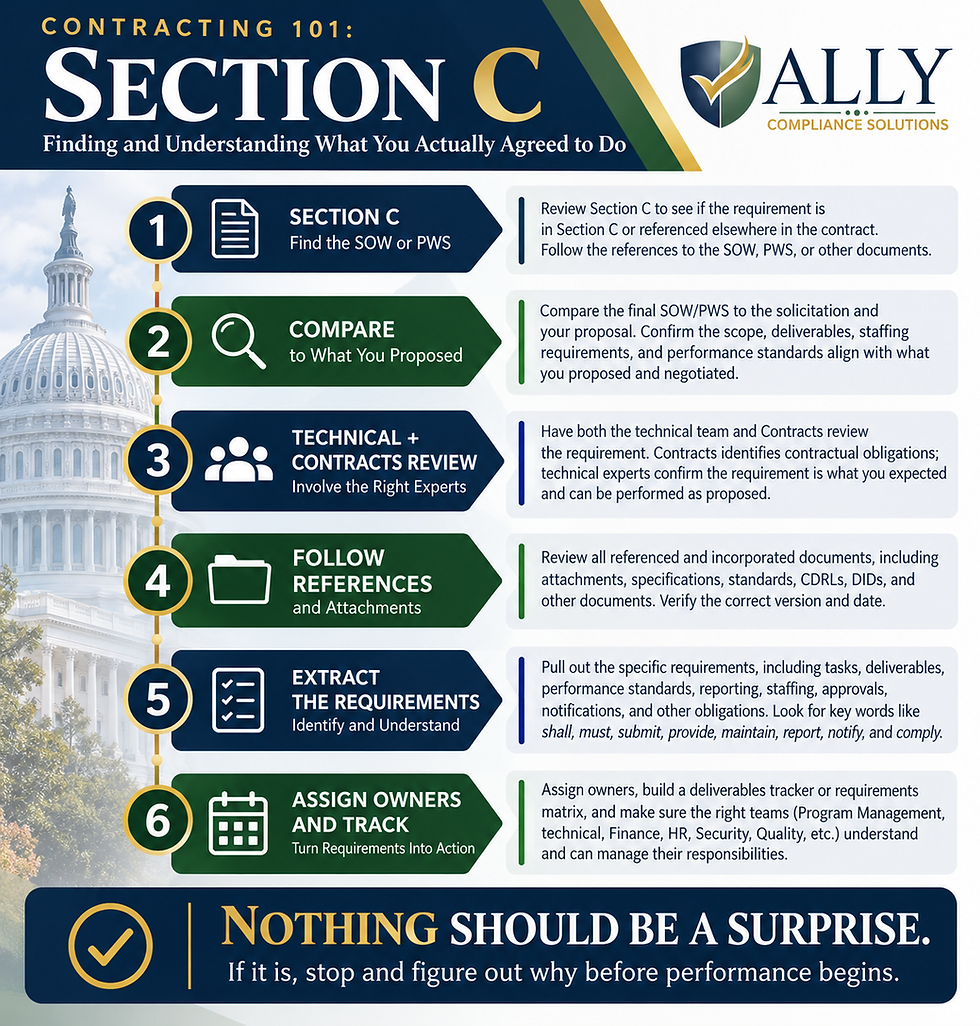
Section C – Description/Specifications/Statement of Work
Translation: What did we actually agree to do?
Section C contains the detailed description of the requirement beyond the basic information in Section B. Depending on the acquisition, that may include a Statement of Work (SOW), Performance Work Statement (PWS), specifications or another description of the work.
During award review, this is another comparison point.
Pull out what your company proposed and compare it against what the government awarded. The technical and program team should confirm that the scope in the contract is the scope the company proposed and agreed to perform.
No surprise additions.
If something appears in the awarded requirement that wasn't part of the proposal or negotiations—or something important is missing—identify it before performance gets underway.
And don't make Contracts perform this comparison in a vacuum. The people who developed and will perform the technical solution are often in the best position to recognize a subtle change in scope.
Who should pay attention: Contracts Administration, Program/Project Manager, Technical Lead and other subject-matter experts responsible for performance.
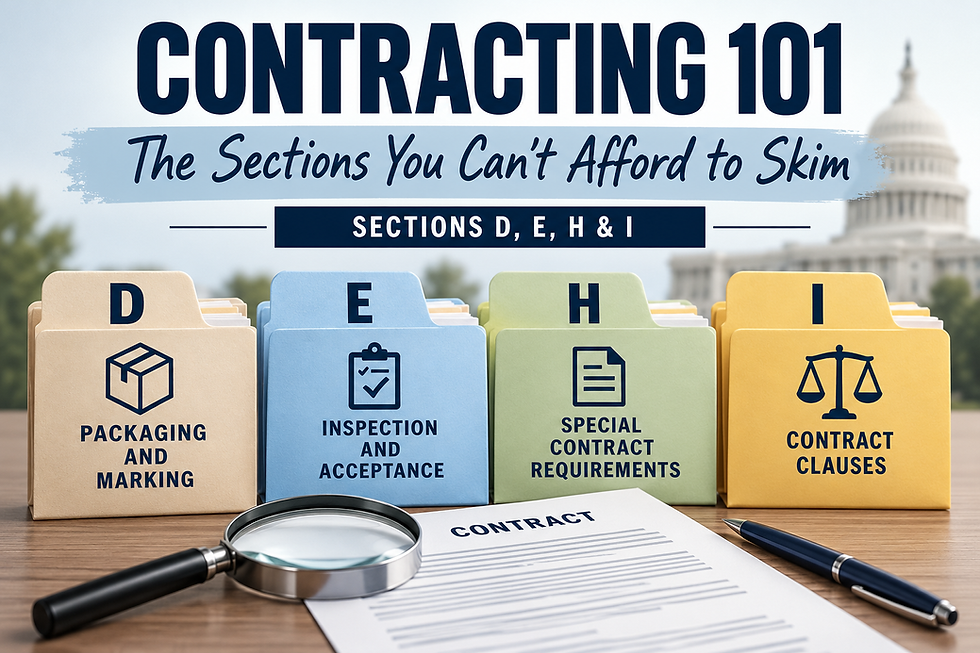
Section D – Packaging and Marking
Translation: If you're delivering products, how do they need to be packaged and marked?
Section D contains packaging, packing, preservation and marking requirements when applicable.
For many service contracts, there may be little or nothing here. For contracts involving products or physical deliveries, however, these requirements can be very important.
Determine whether Section D applies to your contract and, if it does, make sure the people responsible for the physical deliverable understand exactly what the government requires.
Who should pay attention: Contracts Administration and, when applicable, Logistics, Operations, Shipping, Quality and whoever is responsible for preparing physical products for delivery.
Section E – Inspection and Acceptance
Translation: How will the government determine that what we delivered is acceptable?
Section E addresses inspection and acceptance requirements. Depending on the contract, these requirements may apply primarily to specific deliverables or have broader implications for performance.
Either way, pay attention to how acceptance will be documented.
Delivering something and having the government formally accept it aren't necessarily the same event. Acceptance can affect invoicing, payment, performance documentation and ultimately contract closeout.
During your review, determine who performs inspection or acceptance, where it occurs, what requirements apply and how acceptance is documented. Then make sure the people responsible for the deliverable understand that process.
Who should pay attention: Contracts Administration, Program/Project Manager, Technical Lead, Quality, Accounting/Billing and anyone responsible for producing or submitting deliverables.
Section F – Deliveries or Performance
Translation: When and where do we have to perform?
Section F addresses the time, place and method of delivery or performance.
This is where you'll want to validate important dates and performance requirements, including the Period of Performance (POP), delivery schedules and place of performance.
If the contract includes a base period and option periods, understand the distinction. An option period appearing in the contract doesn't necessarily mean the government has exercised that option or that you are currently authorized to perform it.
Compare the awarded dates against what was proposed and negotiated. Then make sure the dates that matter actually make their way into the systems and tools your company uses to manage the project.
Don't let an important contractual deadline live only inside a PDF.
Who should pay attention: Contracts Administration, Program/Project Manager, Program/Project Controls, Technical Leads and anyone responsible for scheduling or deliverables.
Section G – Contract Administration Data
Translation: Information you'll need to administer—and often set up—the contract.
Section G contains contract-administration information and instructions and may include accounting, appropriation and payment-related information.
This is another piece of the project-setup puzzle.
Review the accounting and funding information, administrative instructions and other data that affect how the contract will operate internally. Consider this information together with Section B, Section F and other applicable contract requirements before finalizing the project's setup.
The contract should drive the setup—not the other way around.
We'll come back to project setup later in this series because several pieces of the contract need to be considered together.
Who should pay attention: Contracts Administration, Accounting/Finance, Billing, Program/Project Controls and whoever is responsible for project setup.
Section H – Special Contract Requirements
Translation: Do not skip this section.
Section H contains special contract requirements that aren't included in Section I or elsewhere in the UCF.
This is one of the sections I worry about when someone tells me, "I read the SOW and checked the clauses."
Great. Did you read Section H?
These requirements can be specific to this particular contract and can have very real implications for how you perform and administer the work.
During award review, don't just read Section H. Identify requirements that need an owner, a deadline, an internal process or ongoing monitoring.
A requirement isn't managed simply because someone highlighted it in a PDF.
Who should pay attention: Contracts Administration and every functional owner affected by a particular requirement—including Program/Project Management, Security, Human Resources, Accounting, Quality, Information Technology and others as applicable.
Section I – Contract Clauses
Translation: The contractual rules that apply to the award.
Section I contains applicable contract clauses. These may include FAR clauses, clauses from agency-specific FAR supplements and other clauses applicable to the contract.
For an initial award review, don't simply acknowledge that Section I exists. Determine what those clauses require your company to do.
Which clauses create reporting requirements? Which establish notice requirements? Which affect invoicing or payment? Which contain restrictions or require government approval? Which need to be flowed down to subcontractors? Which impose requirements on functions outside Contracts?
We'll spend much more time on clauses later in this series. For now, the important point is that a clause review should result in actionable requirements, not just a list of clause numbers.
Who should pay attention: Contracts Administration should lead the review, with requirements routed to Legal, Accounting/Finance, Human Resources, Security, Procurement/Subcontracts, Program Management and other functional owners as applicable.
Section J – List of Attachments
Translation: These are not optional reading. They are part of your contract.
Section J lists the documents, exhibits and other attachments incorporated into the contract.
Now go back to the exercise we performed with the cover page.
Reconcile the list.
If Section J says there are 12 attachments, can you locate all 12?
Check the title. Check the date. Check the revision. Check the number of pages when identified.
And then read them.
Each item listed in Section J is incorporated into the contract. These documents can contain requirements that matter just as much as requirements printed in the main contract document.
You need to know what they say.
Depending on the contract, Section J may include a Statement of Work (SOW) or Performance Work Statement (PWS), Contract Data Requirements Lists (CDRLs), Data Item Descriptions (DIDs), wage determinations, technical specifications, drawings, security requirements, Government-Furnished Property (GFP) lists, quality requirements, pricing schedules or other contract-specific documents. Not every contract will include all—or even most—of these, but don't assume an attachment is administrative or unimportant based on its title. Understand what it requires and who within your organization needs to know about it.
This is also where good document control becomes extremely important.
Preserve the original award package together. You should always be able to go back and reconstruct exactly what the contract looked like on the day it was awarded.
If an attachment is later revised, replaced or otherwise changed through a contract modification, don't simply overwrite the original file with the new version. Maintain the original and clearly identify the updated version and the modification that incorporated it.
Years later, you may need to answer two very different questions:
What does the contract require today?
and
What did the contract require when it was originally awarded?
Your contract file should allow you to answer both.
Who should pay attention: Contracts Administration should maintain the authoritative contract file, but Program/Project Management, Technical Leads, Quality, Security, Accounting and other functional owners should review attachments applicable to their responsibilities.
What About Sections K, L and M?
Sections K, L and M primarily concern the solicitation and proposal process.
Section K – Representations, Certifications and Other Statements of Offerors or Respondents: The representations, certifications and other information required from the offeror.
Section L – Instructions, Conditions and Notices to Offerors or Respondents: In plain terms, the government's instructions for preparing and submitting the proposal.
Section M – Evaluation Factors for Award: How the government said it would evaluate offers.
If you're reviewing an awarded contract and don't see Sections K, L and M physically included, don't immediately assume something is missing. Under the UCF, Part IV isn't physically included in the resulting contract after award. Applicable representations and certifications are incorporated by reference as prescribed by the FAR.
This is exactly why understanding the structure matters. You need to be able to distinguish between something that's missing and something that isn't supposed to be physically included in the awarded contract.
Your Award Review Should Produce Action
Contracts Administration should read the entire contract, but a good award review shouldn't end with one person understanding it.
The appropriate stakeholders across the organization need to understand the portions that affect their responsibilities.
Pricing should confirm that the awarded pricing and structure reflect what was negotiated. The Program/Project Manager and technical team should confirm that the awarded scope is what was proposed. Accounting and Program/Project Controls need the information necessary to establish and manage the project appropriately. Requirements need owners. Deliverables need due dates. Reporting requirements need to be tracked. And Contracts needs to maintain an authoritative contract file containing the complete original award and a clear history of everything that changes afterward.
That's the difference between having a contract and managing one.
Contracting 101: Initial Award Review Checklist
Before you consider your initial award review complete:
Reconcile the cover page. Verify that every section or document identified as incorporated is accounted for.
Preserve the original award. Maintain a complete, untouched copy of the initial award package.
Validate Section B. Compare CLINs, SLINs, quantities, pricing, contract type and other relevant structure against the final proposed and negotiated position.
Validate the scope. Have the appropriate program and technical personnel compare the awarded requirement against what was proposed and negotiated.
Validate dates. Confirm the POP, delivery dates, option periods and other contractual deadlines.
Understand inspection and acceptance. Know who accepts the work, what constitutes acceptance and how it will be documented.
Review Sections G and H carefully. Capture administrative, funding and special requirements that need to drive internal processes or project setup.
Review the clauses for actions. Identify reporting, notice, approval, flowdown and other actionable requirements.
Reconcile Section J. Confirm that every listed attachment, exhibit and document is present and that you have the correct version.
Assign ownership. Identify who within the organization is responsible for each ongoing requirement.
Set up tracking. Move requirements, deliverables and deadlines out of the PDF and into whatever tools your organization uses to manage them.
Document the baseline. Make sure you can always reconstruct what was originally awarded so future modifications can be tracked against it.
A contract isn't something Contracts reads once, saves to a folder and pulls back out when there's a problem.
It is the roadmap for how the company is supposed to perform, bill, deliver, report and comply throughout the life of the award.
Start by making sure you have the whole roadmap.

Comments